
Will AI Take Your Job in 2026? Jobs at Risk, New Roles & How to Stay Safe
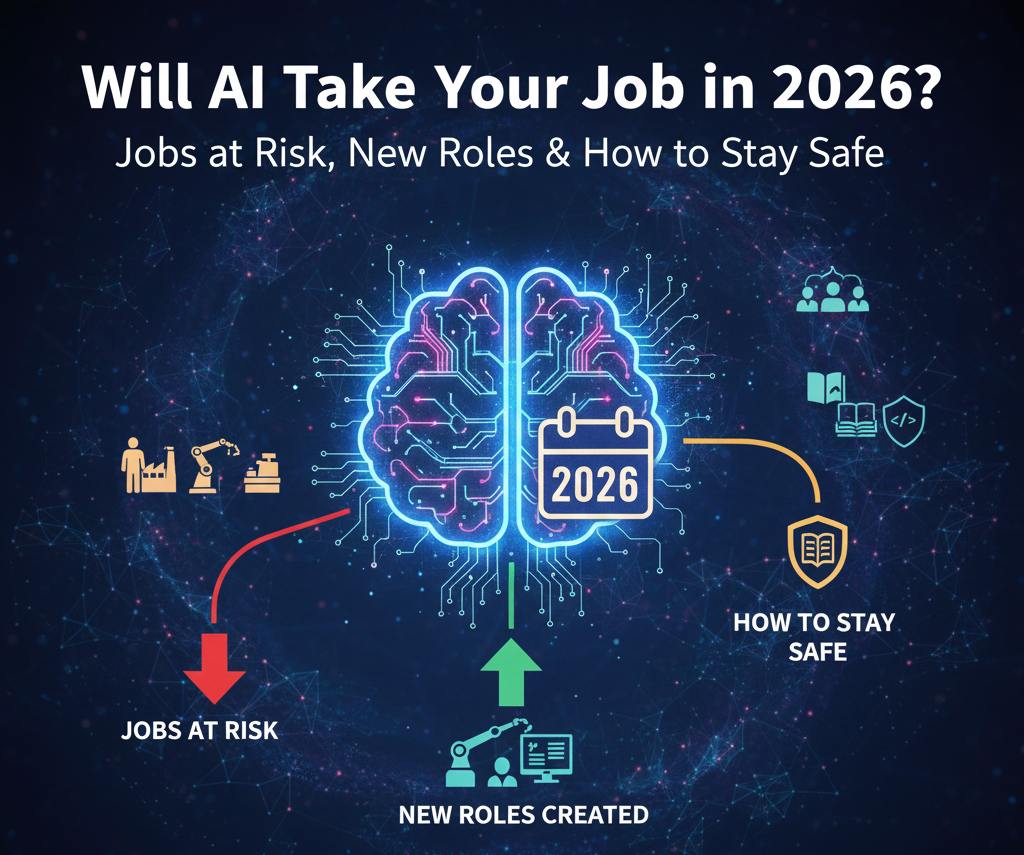
AI will not replace all humans in 2026, but it will heavily reshape how people work, automate repetitive tasks, and shift demand toward more creative, analytical, and AI-augmented roles. This guide explains which jobs are most exposed, which new roles AI is creating, and how to protect and grow your career with smart upskilling.
🔥 Key Trends for AI and Jobs in 2026
- Generative AI automates routine tasks in customer support, basic content, simple coding, and back-office operations, reducing demand for low-skill, repetitive roles.
- At the same time, AI boosts demand for roles in data, product, AI operations, automation consulting, and human‑in‑the‑loop supervision.
- Companies hiring in 2026 prefer “AI-augmented workers” who can use tools like ChatGPT, Gemini, and coding copilots rather than replace humans outright.
SEO keywords: will AI take my job 2026, future of work with AI, AI job market 2026, AI automation trends, jobs vs AI.
😰 1) Jobs Most at Risk from AI
Best for: understanding which roles face the highest automation pressure.
- Repetitive office work: data entry, form processing, basic invoice handling, and simple report generation are increasingly automated by AI and RPA platforms.
- Basic content and support: low-cost article spinning, FAQ support, first-level chat support, and script-based telemarketing are easily handled by chatbots and generative AI.
- Routine coding and testing: boilerplate code, CRUD apps, and basic QA tests are now supported by AI coding assistants, reducing headcount needs for purely junior repetitive tasks.
SEO keywords: jobs AI will replace 2026, AI replacing jobs list, automation risk jobs, low skill jobs AI, repetitive jobs AI.
💼 2) Jobs AI Will Transform (Not Replace)
Best for: roles that survive by evolving into AI‑augmented work.
- Marketing & content: marketers and writers who learn AI tools move from manual production to strategy, editing, and multi-channel orchestration.
- Software development: developers use AI for scaffolding and debugging but focus more on architecture, integration, security, and product thinking.
- HR, sales, and operations: professionals use AI for candidate screening, lead scoring, forecasting, and workflow automation while keeping human relationship roles.
SEO keywords: jobs safe from AI 2026, AI augmented jobs, future proof careers, AI in marketing jobs, AI in software development.
🚀 3) New Jobs AI Is Creating by 2026
Best for: spotting new, growing career paths.
- Prompt engineers & AI content strategists: experts who design prompts, templates, workflows, and style guides for AI systems to deliver consistent outputs.
- AI operations & automation specialists: roles focused on building, monitoring, and optimizing AI pipelines, chatbots, and workflow automations across tools.
- AI trainers, evaluators, and ethicists: people who label data, review outputs, design guardrails, and ensure compliance with regulations like the EU AI Act.
SEO keywords: new AI jobs 2026, prompt engineer career, AI operations jobs, AI ethicist, AI automation consultant.
📊 4) Industries Most Impacted by AI in 2026
Best for: sector-level view of risk and opportunity.
- High automation pressure: BPO, call centers, basic IT services, routine financial ops, and entry-level content services see margin and headcount pressure as AI cuts costs.
- High augmentation opportunity: healthcare, education, software, manufacturing, logistics, and creative industries use AI as a copilot to boost productivity, not replace humans entirely.
- Small businesses & freelancers: solopreneurs use AI to compete with bigger teams in design, marketing, and customer support, creating new micro‑entrepreneur roles.
SEO keywords: industries AI will disrupt 2026, AI in BPO, AI in healthcare jobs, AI in education jobs, AI for small business.
🧠 5) Skills You Need to Keep Your Job
Best for: practical upskilling roadmap for 2026.
- AI literacy: ability to use tools like ChatGPT, Gemini, Claude, and coding copilots, including prompt design, verification, and workflow integration.
- Human skills: communication, critical thinking, problem-solving, storytelling, negotiation, and leadership become more valuable as AI handles routine tasks.
- Data & digital skills: comfort with spreadsheets, dashboards, basic analytics, and no-code/low-code tools to build simple automations and reports.
SEO keywords: how to keep your job with AI, AI skills for 2026, future proof skills, AI literacy, upskilling for AI.
🛠️ 6) How to Use AI to Secure (Not Lose) Your Job
Best for: turning AI into your advantage at work.
- Become the “AI person” on your team: learn a few key tools deeply (chatbots, AI writing, AI coding, AI analytics) and proactively suggest automations that save time and money.
- Document and measure your impact: track hours saved, leads generated, or quality improvements from AI-powered workflows and show this in reviews and portfolios.
- Build a personal AI stack: mix general assistants (ChatGPT, Gemini) with niche tools (coding copilots, design AI, CRM AI) tailored to your role or freelance niche.
SEO keywords: how to use AI at work, use AI to boost productivity, AI tools for employees, AI workflow automation, AI side hustles 2026.
🌍 7) Freelancing, Side Hustles, and AI in 2026
Best for: people wanting extra income or career backup.
- Popular AI side hustles: AI-assisted content creation, niche SEO blogs, YouTube scripting, design templates, and building chatbots for local businesses.
- Global freelance platforms: clients increasingly expect freelancers to use AI for speed, but still pay for strategy, creativity, and implementation quality.
- Personal brand & portfolio: showing AI‑enabled case studies (before/after, time saved, revenue impact) becomes a differentiator in saturated markets.
SEO keywords: AI side hustle ideas 2026, freelancing with AI, make money with AI tools, AI for creators, AI for freelancers.
🧭 8) How to Plan Your Career for an AI-Heavy 2026
Best for: long-term planning, not just fear-based reaction.
- Audit your current role: list tasks as repetitive vs creative vs relationship-based; assume repetitive tasks will be automated first and plan accordingly.
- Pick one growth direction: go deeper into your domain with AI (e.g., AI‑powered marketer) or move sideways into AI‑specific roles (e.g., automation specialist).
- Create a 6–12 month learning plan: combine online courses, hands-on practice with AI tools, and small, real projects that you can showcase to employers and clients.
SEO keywords: future of work with AI 2026, AI career planning, reskilling for AI, AI proof your career, long term AI strategy.
On-Page SEO Checklist for This Topic
- Target primary keyword: “will AI take my job 2026” plus variations like “jobs AI will replace 2026” and “jobs safe from AI 2026” in title, H1, and intro.
- Use H2/H3s by theme (jobs at risk, new jobs, skills, side hustles) and include internal links to AI tools and career/skills guides on your site.
- Add FAQ schema with questions such as “Will AI replace my job by 2026?”, “Which jobs are safe from AI?”, and “How can I use AI to keep my job?”.
- Refresh at least every 6–12 months with new data, case studies, and regulations (e.g., new AI policies or labor market reports).
Final Take
By 2026, AI is more likely to replace tasks than entire professions, putting unskilled, non‑adaptable roles at risk while rewarding people who learn to work with AI. Use this guide to identify your risk level, choose the right skills to build, and turn AI from a threat into a career accelerator.

Caxtra
Company
Related Articles

Best PS5 Games February 2026 | New Releases, Top Picks & Must-Plays Guide
February 2026 PS5 roundup: Resident Evil Requiem, Nioh 3, Reanimal, plus all-time greats like Astro Bot. Trends, reviews, and SEO keywords for gamers.

Union Budget 2026: Key Market Trends & Investment Opportunities to Watch in February
With Union Budget 2026, RBI MPC decision, and January auto sales shaping February markets, discover sector winners, investment strategies, and volatility triggers for savvy investors.